


A Non-Ordinary Experience and a Possible Dimensional Overlap
There are stretches of time in my life when things move along quietly. Days unfold without other worldly visitations, without vivid dreams that echo for weeks, without moments of unmistakable contact or sensation that seem to arrive from beyond the familiar edges of reality. Those seasons don’t trouble me. I’ve come to recognize them as part of a natural rhythm—life settling into itself, doing what it does best, weaving meaning through routine, anchoring us into the human cadence of days, responsibilities, weather, and all the rest.
And then, occasionally, something else happens.
When reality opens just a fraction wider—when something unexpected slips through—it carries a different weight. The texture of the day changes. Awareness sharpens. Everything that follows seems to orbit that moment in subtle ways. This is a story about one of those moments.
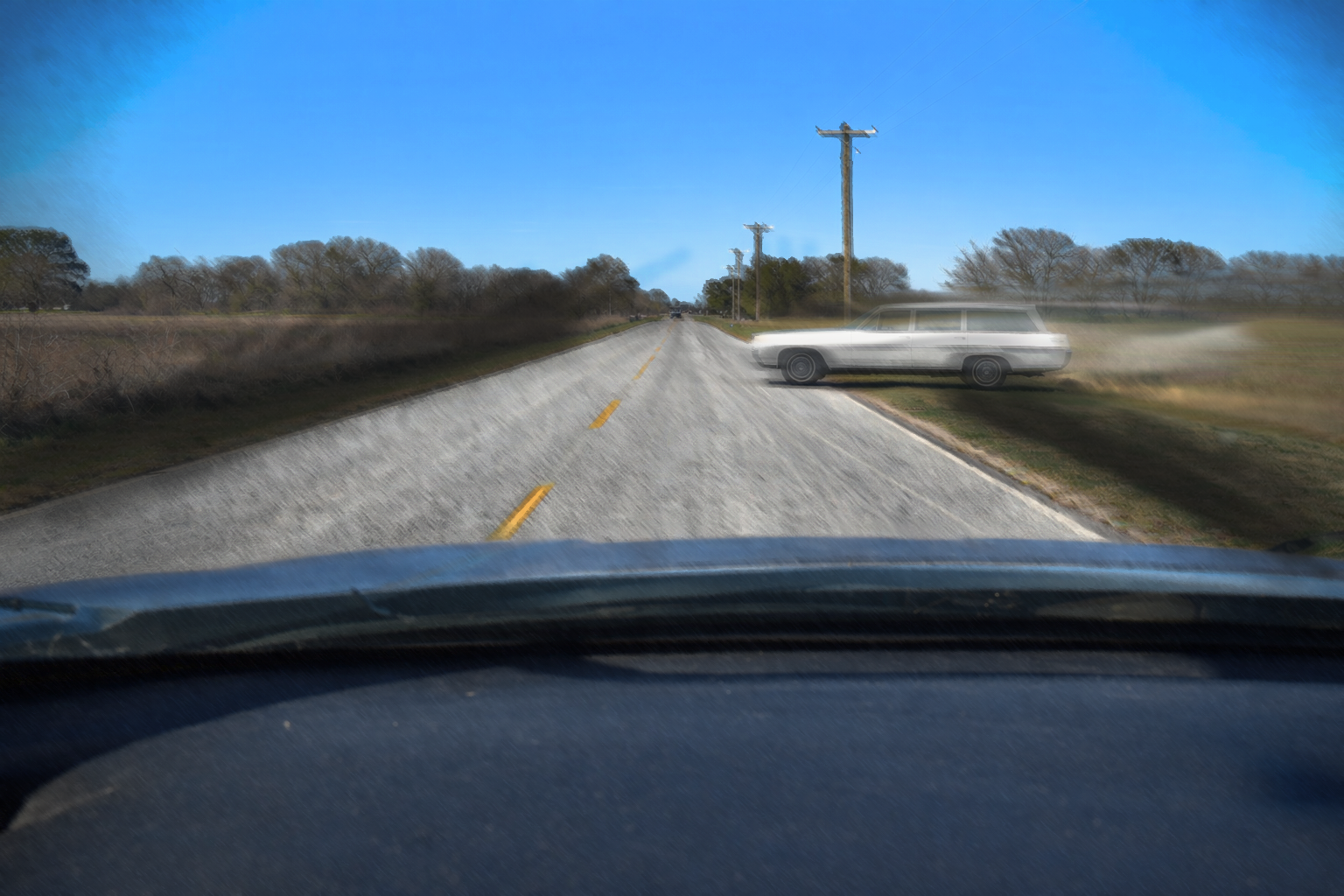
I had just pulled out of our driveway, easing onto the rural Kansas road I know so well it feels etched into my nervous system. I hadn’t gone more than a quarter mile when I saw it: Ahead of me, crossing the road from right to left at a fairly high rate of speed, was an old-fashioned white station wagon.
It registered immediately as something from another era. Boxy. Plain. Familiar in a way that reached back into childhood memory—1960s, maybe early 1970s. The kind of station wagon many small towns once used as ambulances, before emergency vehicles took on their current forms. I didn’t notice any markings. I couldn’t make out a driver. What stood out was the car itself—solid, defined, purposeful—moving quickly across my line of sight.
What caught me completely off guard was the location. There was nothing like a road or driveway or even flat ditch where I watched the station wagon cross.
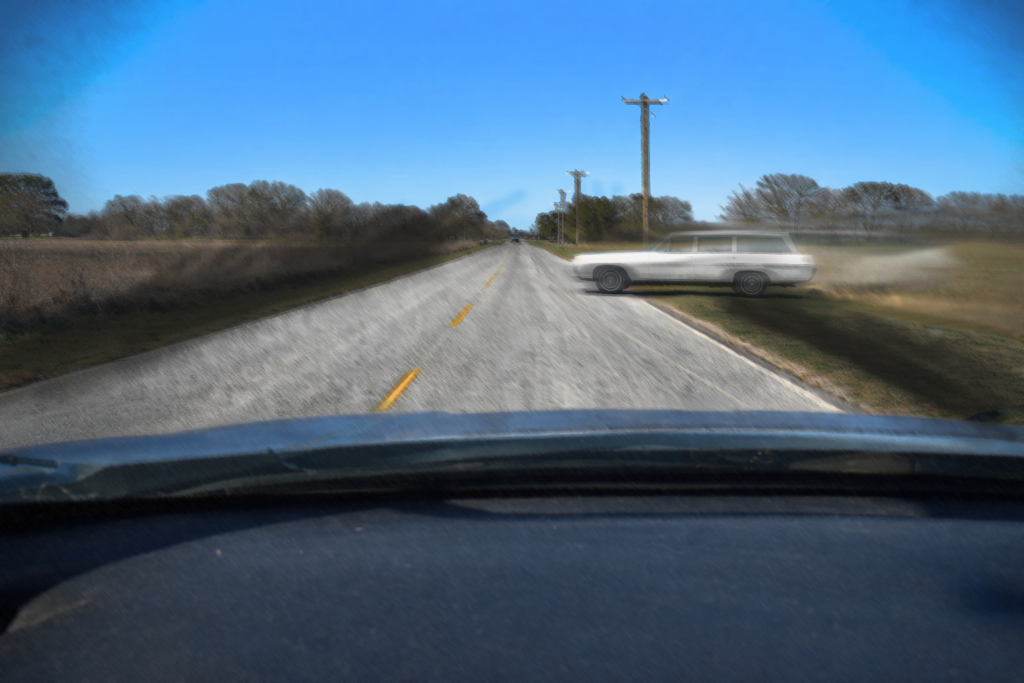
I live in rural Kansas, where the roads are all exactly one mile apart laid out like a grid and every driveway is memorized because, well, there just aren’t very many of them. The place where this station wagon crossed lay just beyond our closest neighbor’s driveway—a very short one that leads directly to the house. On the opposite side of the road is another neighbor’s property, gated and always closed. The two driveways don’t connect, and there’s no hidden access point between them, and there are no roads or driveways before or after these two properties.
As I continued driving, my attention locked onto that exact spot. When I reached it, the landscape revealed itself exactly as it always has: deep ditches on either side, trees, open rangeland, the familiar quiet of the area.
Yet the image remained vivid.
I can still see the moment clearly—the way the chassis dipped slightly, as cars do when crossing uneven ground, the sense of speed, the way it moved as though responding to an intersection that simply wasn’t there. The experience stayed with me, replaying itself in my mind throughout the day.
This felt different from the kinds of impressions I sometimes perceive internally, the subtle images or knowings that arrive through intuition or inner vision. Those experiences come more frequently for me and carry their own kind of impact. This, however, presented itself as something external and visually concrete, something my senses registered in the same way they register the physical world. That car had a shadow. It was anything but ghostly.
The rest of the day carried a different quality after that. Not dramatic, but altered—quietly focused, contemplative, attuned. Something had shifted, and it stayed with me.
A few weeks prior my husband had a somewhat similar experience. He had been driving at dusk, maybe just past, on a road perpendicular, roughly four to five miles away. In a rural place like this, that still feels like the same neighborhood. He told me he saw what appeared to be the tail light of a vehicle, or was it a red orb? Moving quickly across the road in front of him. Like I did later, he mentally marked the spot as he continued driving. When he reached it, the land opened into pasture on both sides, fenced and uninterrupted, with no visible access point.
When he relayed his story I remember listening and feeling that familiar inner pause—the sense that something was worth holding gently rather than dismissing. Tom doesn’t typically linger on these moments the way I do. He noticed it, acknowledged it, but didn’t talk about it any more. I carried it forward.
When my experience with the station wagon unfolded, that earlier conversation came rushing back. Mine happened in full daylight, under clear skies, with bright sunshine illuminating everything around me. Tom’s had occurred in low light and some fog, where edges soften and perception carries a different quality. Together, though, the two experiences felt related—like echoes passing through the same landscape at different times. Neither experience was logically explainable.
“You know,” he said when I told him about the station wagon sighting “those used to be ambulances when we were kids.”
That opened another layer of contemplation. Was there something personal in that image? A memory surfacing? A symbol meant for one of us, or both of us? Or was it simply the form this moment took—a familiar shape borrowed from another time?
I don’t rush toward conclusions with experiences like this.
Over the years, I’ve learned to let them remain open, allowing meaning to unfold slowly, or sometimes simply allowing the experience itself to be enough. Some non-ordinary moments arrive less as messages and more as reminders—a gentle tap on the shoulder from the mystery itself.
“Remember,” they seem to say.
“Reality extends further than it appears.”
As I was later thinking about how to write this experience and even considering possible titles, I glanced at the clock and saw 1:44 —my most familiar numerical nudge. Another quiet confirmation that the experience carried a larger resonance and that I was meant to pay attention.
I often think of these moments as possible bleed-throughs from parallel or closely associated realities. Not dramatic portals or cinematic crossings, but soft overlaps—like radio frequencies brushing against each other for a brief instant. Other times, they feel like echoes, traces of layers of life that once moved through the same space.
This area, after all, carries its own history. My neighborhood was once a very different place. In the 1930s and ’40s, when oil activity shaped this region, buildings stood where open fields now stretch. The town—once called Bloomington, Kansas—was alive with movement, industry, and people. When that chapter closed, much of it receded, leaving the land quieter but not empty of memory.
Perhaps the station wagon belonged to another time entirely. Perhaps it belonged to another version of now.
I don’t believe I’m particularly special, and I’ve never believed that moments like these are reserved for a select few. What I do believe is that attention makes a difference. Paying attention to subtle shifts, fleeting impressions, and moments that fall outside our expectations creates space for more of them to arise. Having wonderment widens perception.
It’s entirely possible that Tom’s experience, our conversation about it, and the space we gave it helped invite my own. It’s also possible that sharing these stories—speaking them aloud, writing them down, allowing them to be witnessed—acts as an invitation in itself. Even reading about experiences like these can do that. I have a few stories that make that statement undeniable.
Life is layered, mysterious, and alive in ways that reach beyond easy explanation. When we remember that, something softens. Awareness expands. The ordinary stretches just enough to include the extraordinary.
And sometimes, a white station wagon crosses a road that exists only for a moment—long enough to remind us that reality has many more pathways than we usually notice.
